
- Published on
Extraction: The Attribution Engine
- Authors

- Name
- Ben Lesh
Home | Concept | Extraction | Payment | Usage | Corpus
What makes Proteus work is its ability to identify specific, attributable creative elements with remarkable precision. This isn't just detecting "similar colors" or "same genre" - it's recognizing the distinctive creative choices that make work recognizable and influential.
Here's what that looks like in practice.
Example: Visual Attribution Analysis
Let's look at a mashup image combining elements from two famous works:
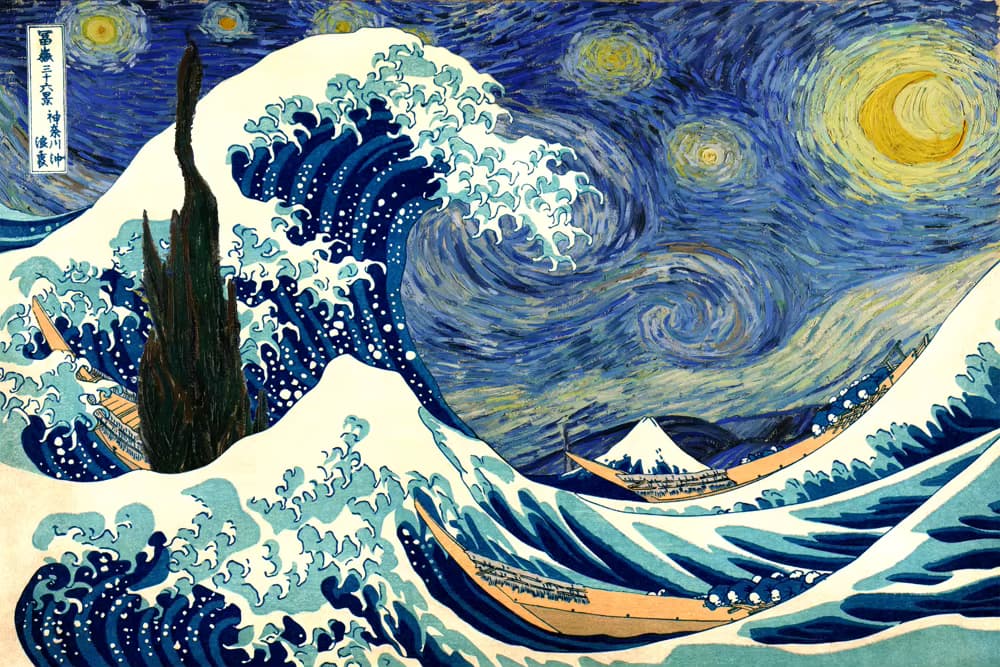
Without revealing how the extraction works, here's what Proteus can identify:
Distinctive Element 1: Wave Structure
- Description: Towering wave form with foam rendered as downward-curling claw-like projections, fragmenting into scattered circular droplets
- Visual signature: Asymmetric crest, dark indigo-to-teal gradient interior, foam fingers creating negative space
- Attribution confidence: 95%
- Recognition: Strongly associated with specific historical work
Distinctive Element 2: Sky Treatment
- Description: Concentric swirling brushstrokes creating multiple rotational vortex centers across sky region
- Visual signature: Counter-clockwise spiral motion, blue-white-yellow color bands following curved paths, thick impasto texture with visible stroke direction
- Attribution confidence: 95%
- Recognition: Strongly associated with specific artist's technique
Distinctive Element 3: Vertical Silhouette
- Description: Dark flame-shaped form with undulating edges, tapering to point, rendered in deep green-black
- Visual signature: Interrupts horizontal composition, wavy contour suggesting movement, darkest value mass in composition
- Attribution confidence: 85%
- Recognition: Strongly associated with specific artist's motif
Novel Element 1: Compositional Fusion
- Description: Botanical element (typically terrestrial) emerging directly from ocean surface with no land connection
- What makes it novel: Combines two incompatible spatial contexts from different source works
- This becomes: A borrowable node for future derivatives
Novel Element 2: Boundary Dissolution
- Description: Wave forms and sky patterns share identical swirling motion, eliminating clear horizon through unified technique
- What makes it novel: Erases spatial boundaries present in both source works
- This becomes: A borrowable node for future derivatives
The Execution Layer: What Gets Extracted vs What Gets Skipped
Proteus doesn't just look at what's in the work—it looks at HOW it's executed.
Subject matter (usually skipped):
- "Has a wave" ← Too generic
- "Has a night sky" ← Too generic
- "Has a tree" ← Too generic
Execution (extracted):
- "Wave foam rendered as claw-like downward projections with fragmenting droplet scatter" ← Specific technique
- "Sky rendered as concentric swirling brushstrokes with multiple vortex centers" ← Specific treatment
- "Tree rendered as flame-shaped form with undulating edges in impossible marine context" ← Specific compositional choice
This is the difference between detecting content and detecting creativity.
The LLM Choice: Claude vs Gemini
Proteus currently uses Anthropic's Claude for element extraction, with periodic testing against Google's Gemini. Here's why, and what the differences look like:
Performance Comparison
Claude Advantages:
- Higher specificity in element descriptions (more detailed creative vocabulary)
- Better consistency across multiple extractions of the same work
- More reliable JSON structure compliance
- Superior at identifying novel vs borrowed elements
- Stronger performance on abstract or conceptual creative choices
Gemini Advantages:
- Faster processing time (approximately 30% faster)
- Lower API costs (approximately 40% cheaper)
- Better at identifying technical photographic elements (aperture, exposure techniques)
- Strong performance on geometric and mathematical patterns
Real-World Example: Same Image, Different LLMs
Input: Digital artwork mashup (same as example above)
Claude Output Highlight:
"Foam rendered as downward-curling claw-like projections, fragmenting into scattered circular droplets, creating dramatic negative space beneath crest"
Gemini Output Highlight:
"White foam at wave crest breaking into spray pattern, multiple droplets dispersing upward and outward"
The difference: Claude captures the distinctive creative execution ("claw-like projections," "dramatic negative space"). Gemini describes what's happening more literally ("spray pattern," "droplets dispersing").
For attribution, I need the distinctive execution language. That's why I use Claude for now.
What This Enables
High-quality extraction is the foundation for everything Proteus does:
Accurate Attribution: When you can identify specific creative choices, you can match them against a corpus and build precise attribution graphs. "This work is 45% similar to Work A and 32% similar to Work B" becomes meaningful when the percentages represent actual creative overlap, not vague similarities.
Meaningful Discovery: Consumers can search for specific creative qualities. "Find me stories with unreliable narrator reveals but without mystery genre framing" only works if the system can distinguish technique from genre. "Show me visual art with spiral motion treatments but without celestial themes" requires understanding execution vs subject matter.
Fair Payment: Creators only get paid for the distinctive contributions they actually made. Generic foundational patterns don't generate payments (though they're tracked for discovery). Specific innovative techniques earn ongoing revenue as others use them. This fairness builds trust.
Novel Node Creation: When Proteus identifies elements that don't match anything in the corpus, those become new borrowable nodes. Future works can match against them. This is how the attribution graph grows and becomes more valuable over time.
Coming soon:
- Audio analysis (melodic patterns, harmonic progressions, production techniques)
- Video analysis (editing rhythms, visual storytelling, cinematographic choices)
Each medium requires specialized extraction, but the principle remains the same: identify distinctive creative choices that make works recognizable and attributable.
The goal is comprehensive creative attribution across all media types. I'm starting with visual because it's the easiest to validate and demonstrate. But the vision is much larger.